Architecture · Build vs Buy
Graph API hands you an endpoint.
AI gives you a prototype.
We deliver the platform that production workloads demand.
A Graph call that reads one mailbox is a weekend. A multi-tenant, throttling-aware, auto-scaling, restore-capable collection platform is a roadmap. This is the system behind DataTap — and the equivalent system you would otherwise design, run and staff yourself.
Developer documentationAPI docsThe system, end to end
Five Azure-native services communicate exclusively over durable queues — no service-to-service HTTP. Each worker container is scoped to a single tenant + job and lives only as long as the work.
API orchestrator
A stateless, multi-tenant REST API enqueues typed work (job / custodian / batch) and exposes discovery, monitoring and restore. Routes are tenant-scoped; OData + OpenAPI throughout.
Job & scanner workers
Per-job orchestration runs a reactive pipeline; per-account scanners crawl mailboxes, drives and sites item by item. Fan-out width is the job's parallel-account count.
Queue backbone
Azure Storage Queues decouple every stage and provide natural backpressure. Messages are pulled in batches of up to 32 with resilient, backoff-based retries.
High throughput, low footprint
Concrete defaults, not adjectives.
Reactive streaming pipeline
Backup/restore workflows are System.Reactive observables: discover → validate → schedule runs as a non-blocking stream, so hundreds of custodians flow concurrently instead of marching through a serial loop. I/O is decoupled from queueing via the queue backbone.
Lean workers
Worker containers default to 0.25 vCPU / 0.5 GiB on runtime-only, multi-stage images (no SDK layer) with invariant globalization. Batch-heavy roles size up explicitly; everything else stays small.
Scale-to-zero by default
KEDA Azure-queue scaling drives replica count from queue depth: a replica per ~2 queued messages, activation from zero at ~10 messages, and back to zero when the queue drains. You pay for work, not for idle capacity.
Ephemeral per-job compute
Each job provisions its own container app and scanner queue, then tears them down on completion. No long-lived worker fleet to babysit, right-size, or pay for between runs.
Dynamic provisioning on Azure Resource Manager
Tenants and jobs are infrastructure events, created and destroyed programmatically.
Per-tenant topology
Provisioning spins up a dedicated resource group, serverless Cosmos DB, storage account and Container App environment via ARM — and, on the indexing tier, an Azure AI Search service and a function app.
Full lifecycle
Provision, deprovision and mode-switch (collection ↔ collection+indexing) are first-class, idempotent operations with tracked state — not manual runbooks.
Optimal resource use
Serverless Cosmos bills per request unit, queues cost fractions of a cent per million messages, and normalization runs on consumption-plan functions. Managed identity removes secrets from config entirely.
Subsystem-by-subsystem
What you would build and operate, versus what ships.
| Subsystem | Build on Graph yourself | DataTap |
|---|---|---|
| Graph throttling | You own per-app + per-tenant back-off, 429/Retry-After handling, adaptive pacing, and re-tuning as limits change. | Pre-emptive back-off and throttling mitigation built into the connector layer; resilient retry with exponential backoff on every Graph + queue call. |
| Orchestration | Design a job model, work distribution, fan-out/fan-in, and failure recovery from scratch. | Reactive (System.Reactive) pipeline: sources are discovered, validated and scheduled as an async observable, decoupled onto durable queues. |
| Scaling | Stand up autoscalers, capacity planning, and idle-cost controls; keep workers warm or eat cold-start. | KEDA queue-depth scaling on Azure Container Apps — replicas track queue length, wake from zero on demand, and scale back to zero when drained. |
| Provisioning | Write and maintain IaC, per-customer resource topology, and teardown logic. | Per-tenant resource group, serverless Cosmos, storage, Container App environment and functions created on demand via Azure Resource Manager; full provision / deprovision / mode-switch lifecycle. |
| Isolation | Architect multi-tenant data isolation, secret management, and blast-radius containment — and defend it in audits. | Dedicated resource group per tenant; cert-based app-only OAuth with secrets in Key Vault; revocable, tenant-scoped API keys. |
| Restore | Graph has no bulk-restore primitive — re-injecting items, folders, mailboxes or sites is a separate project. | Bidirectional engine restores content back into OneDrive, SharePoint, Teams and Exchange, from a single item to a whole mailbox or site. |
| Observability | Build job status, per-custodian metrics, error capture and reporting yourself. | Live job status (custodians / items / errors) and retained, consolidated end-of-run reports out of the box. |
| Maintenance | A standing team owns Graph API drift, throttling changes, and auth deprecations indefinitely. | Connectors, scaling and compliance posture are maintained for you behind a stable REST API. |
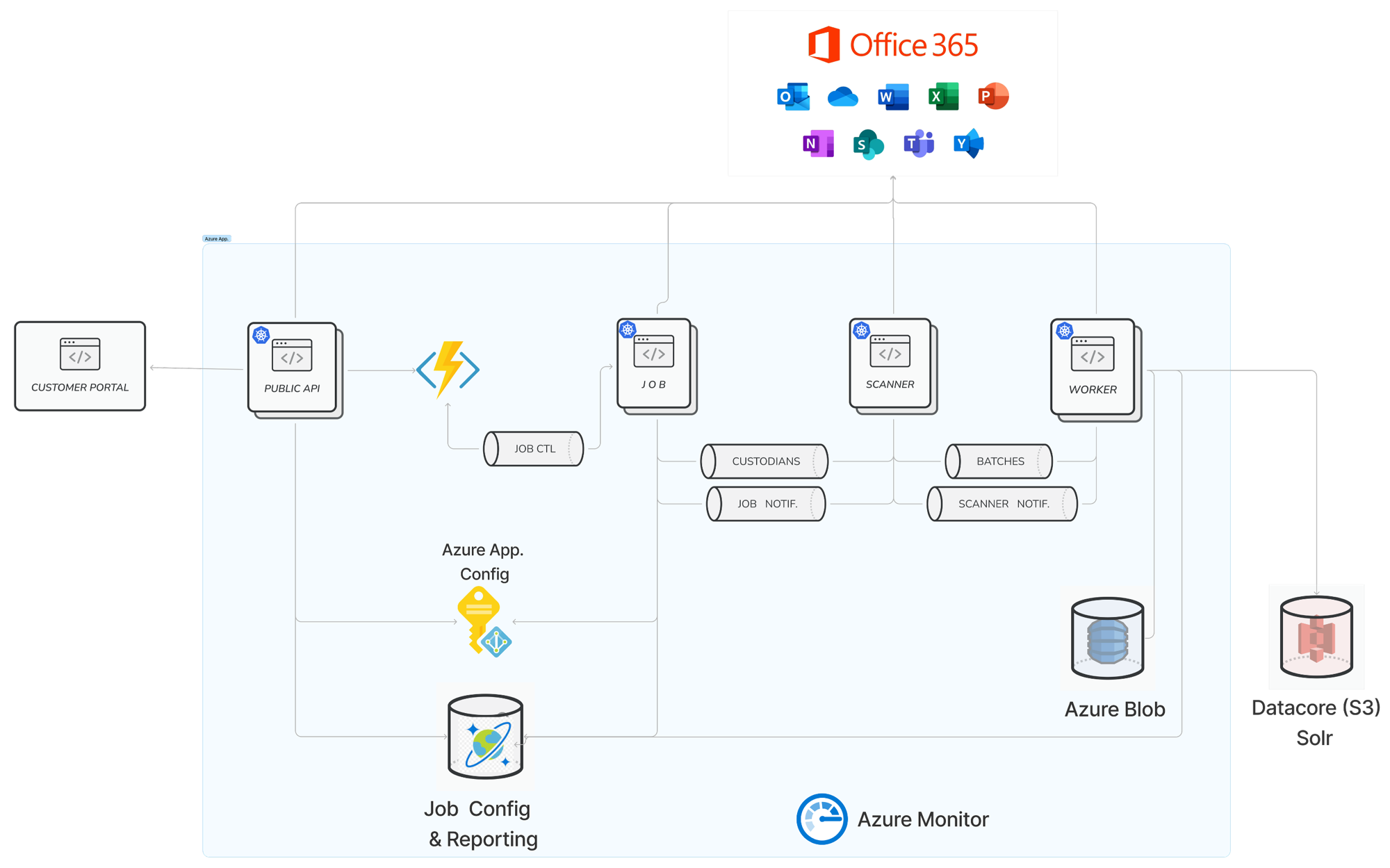
Architecture diagram
Office 365 at the top; Customer Portal and Public API on the left; Job, Scanner and Worker services in the centre communicating over Storage Queues; Cosmos DB, Azure App Config and Azure Monitor for state and observability; Azure Blob and Datacore (S3/Solr) as collection targets on the right.
Security & tenancy
Enterprise-grade isolation is structural, not bolted on.
App-only, cert-based OAuth
Tenant-wide access to mailboxes, drives and sites via certificate credentials — no user impersonation, no refresh-token juggling. Certificates load from Key Vault at runtime.
Dedicated blast radius
One resource group per tenant means a provisioning failure or compromise is contained to a single tenant. The only shared component is the stateless API layer.
Revocable API keys
Keys are admin-issued and tenant-scoped; a key reaches only its own tenant's data, and revocation cuts access immediately.
From zero to first API call in one conversation
The assistant is grounded on the live DataTap documentation, connector specs and API reference. Describe your use case — Exchange collection, OneDrive backup, user scoping, scheduling — and it returns runnable samples in Python, curl, or whatever language your stack uses. Just ask. No digging through docs, no guessing at field names.
Chat for HelpBrowse the recipesRead the architecture, then call it
The developer guides cover the job model, connectors and policies; the API reference is live. Spin up a trial tenant and exercise the endpoints against real data.
Developer documentationStart a free trial